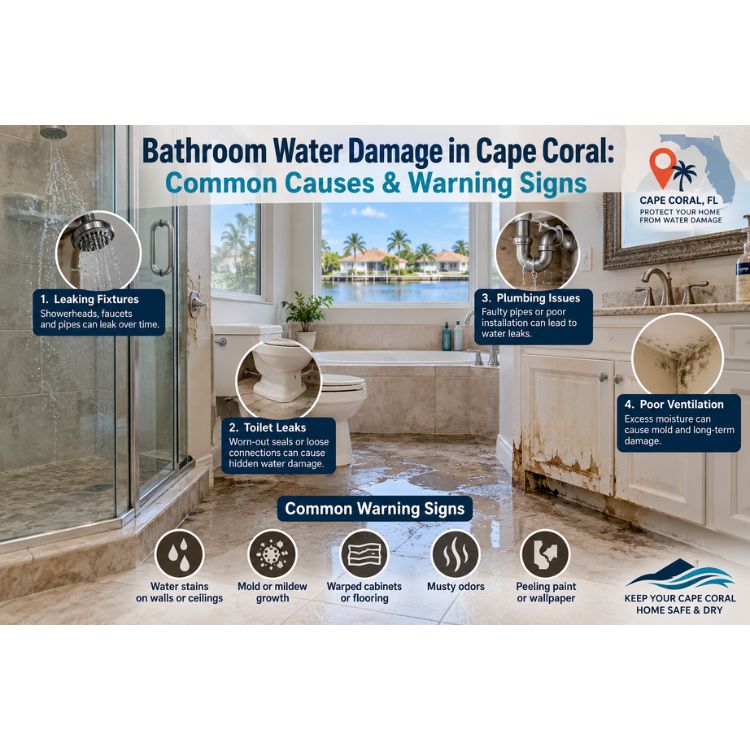
Bathroom water damage in Cape Coral usually starts with a slow leak you can't see: a worn toilet supply line, cracked grout, a failing shower pan, or a pipe in the wall or under the slab. The usual signs are a soft floor, peeling paint, a musty smell that keeps returning, a stain on the ceiling below, and a water bill that jumps for no reason. The urgent step is to stop the water and dry the area fast, ideally within 48 hours, then fix the source before repairing anything.
Facts in this article are cited. Where I'm giving a recommendation rather than a fact, I say so. Where sources disagree, I say that too.
Why leaks do more damage in Cape Coral
Wet drywall dries slowly in humid air, and Southwest Florida air is humid most of the year. That's the core reason a small leak here can become a big repair.
The EPA's water damage guidance is built around a 24 to 48 hour response. Its guidelines are meant to prevent mold by acting before growth starts. The EPA also says that even materials dried within 48 hours may already have mold, and that mold won't always appear after 48 hours, so treat the number as a guideline. One industry write up points out that the "24 to 48 hours" figure is an inference drawn from guidance documents rather than a precise rule, though water-damage responders widely use it. Treat it as a deadline for acting, not a countdown to guaranteed mold.
For humidity, the EPA target as relayed by one university safety office is below 60% relative humidity, ideally 30-50%. Bathrooms in Florida homes can sit above that for hours after each shower if the fan is weak.
Some local factors raise the risk. These are practical observations, not measured Cape Coral statistics:
Slab foundations. Bathroom supply lines often run under the concrete, so a leak there may never leave a stain. One local leak-detection company says Cape Coral's high groundwater table and coastal climate can accelerate pipe corrosion and raise leak risks. That's a company claim, not an independent study.
Mixed home ages. Plumbing condition varies a lot from street to street.
Storm-driven rain. Water can enter through the roof, vents, or windows and show up first on a bathroom ceiling. Not every ceiling stain is a plumbing leak.
What causes bathroom water damage
Toilet leaks
A toilet can leak at the supply line, shutoff valve, tank bolts, or the wax ring under the bowl. The wax ring is the sneaky one. Water goes into the subfloor, and the first clue may be a spongy spot beside the base or a toilet that rocks.
A worn flapper is different. It leaks from the tank into the bowl and wastes water, but it doesn't wet the floor. Utility guidance from Manatee County, Florida, lists a leaking toilet flapper, a leaking faucet, and a cycling water heater as possible causes of water moving through the house. Adding a few drops of food coloring to the tank and waiting about 15 minutes without flushing is a common check. Color in the bowl means the flapper leaks. (That check is standard plumbing practice, not from a cited source here.)
Shower and tub leaks
Cracked grout, dried caulk, or a failing door seal lets in a little water every day. A shower pan leak hides under the tile, so the floor can look fine while the framing below stays wet.
A common mistake: caulking over old, damp, or moldy caulk. It traps moisture. Remove the old bead, let the joint dry completely, then re-caulk. (Recommendation.)
Sink, faucet, and drain leaks
A slow drip inside the vanity can go unnoticed for months. Particleboard cabinets swell when wet and don't fully recover, so warped cabinet bottoms are often the first sign.
Pipes in the wall or under the slab
This is the most damaging category because nobody sees it. Copper pipe can develop pinhole leaks. Explanations vary. A Florida HVAC company points to water chemistry and says three or more pinhole leaks within six months suggest widespread corrosion. A plumbing forum thread lists chloramines in municipal water, corrosion particles from aging water heaters, and high water pressure as commonly cited causes. The sources don't agree on one cause, and both are informal. (Recommendation: have a licensed plumber look at your pipe type, age, and water pressure before you decide between a patch and a re-pipe.)
Failed waterproofing behind tile
Grout and tile alone aren't waterproof. A membrane or coated backer behind them is supposed to stop water. If it's missing or damaged, water leaks behind the shower wall and rots the framing for years before anything shows.
Poor ventilation
Some damage comes from steam, not a leak. Fan sizing sources give slightly different numbers, so here's how they compare:
Source | Guidance |
|---|---|
Building code (as summarized by a builder guide) | At least 50 CFM for intermittent use or 20 CFM for continuous use. |
Home Ventilating Institute (HVI) | 1 CFM per square foot for bathrooms up to 100 sq ft; for larger ones, 50 CFM each for toilet, shower, and tub. |
Code is a minimum. HVI's number is what a properly sized fan looks like. An 8×5 bathroom (40 sq ft) hits code at 50 CFM. The fan should run about 20 minutes after use. Code also says exhaust must not discharge into an attic or crawl space. In Florida, a bathroom fan that dumps into the attic can wet the attic instead.
Warning signs, and what each usually points to
What you notice | Likely cause | Check next |
|---|---|---|
Soft or spongy floor near the toilet | Wax ring or supply leak | Toilet base and shutoff valve |
Hollow-sounding or rocking tile | Wet or weak subfloor | Grout lines, shower threshold |
Bubbling or peeling paint | Moisture in the wall | Both sides of the wall, including the next room |
Ceiling stain in the room below | Leak from above | Tub, toilet, and drain area |
Musty smell that returns after cleaning | Hidden moisture or mold | Under the vanity, behind the toilet |
Caulk that keeps turning black | Water behind the tile | Shower pan and tile joints |
Swollen baseboard or door trim | Water at floor level | Along the tub or shower wall |
Higher water bill, same habits | Leak somewhere | Meter test (below) |
Meter test
Florida utilities describe the same method. Manatee County's version: with all water off, the flow indicator on the meter should be perfectly still; if it moves, water is going somewhere. Then turn off the house's main shutoff valve. If the indicator stops, the water is moving inside the house. If it keeps moving, the water is moving between the meter and the house. A leak under the slab shows up as inside the house, so this test can't tell a slab leak from a wall leak. A leak-detection company can.
Press test (recommendation)
Press the drywall near the tub or toilet with your palm. It should feel firm. Soft, crumbly, or cool spots point to moisture.
Rain or plumbing?
A stain that shows up only after heavy rain points to a roof or wall intrusion. One that shows up while the shower runs points to plumbing.
Can a bathroom leak cause mold?
Yes. Mold needs moisture and something to feed on. Drywall paper, framing, insulation, and subfloor all work. A slow leak supplies the moisture, and the wall hides the growth.
The EPA guidance on clean water damage says ceiling tiles and both cellulose and fiberglass insulation should be discarded and replaced. For wallboard, it may be dried in place if there is no obvious swelling and the seams are intact; otherwise it should be removed, discarded, and replaced.
Small mold patches on hard surfaces are often a homeowner job. Larger areas, repeat growth, or mold inside a wall call for a professional. Move faster if anyone in the home has asthma or a weakened immune system.
What to do first
Stop the water. Close the fixture shutoff, or the main valve if you can't find the source.
Cut power to the bathroom if water is near outlets or lights.
Photograph everything before you clean.
Remove standing water and wet items. Run a dehumidifier and fans.
Fix the source before drying or rebuilding.
Get moisture readings before walls are closed. Restoration companies use moisture meters and thermal cameras to find wet spots without opening everything up.
Don't paint or caulk over damp surfaces. Don't assume a dry-looking wall is dry.
Clean water vs. contaminated water
This changes the response. The EPA's 24 to 48 hour guidance covers clean water. If the water may be contaminated with sewage, chemicals, or biological pollutants, protective equipment and containment are required, and an experienced professional should be consulted. A supply-line leak is clean water. A toilet overflow or sewer backup is not, so skip the DIY drying.
How restoration works
Find and fix the source.
Map the moisture.
Remove what can't be saved: swollen drywall, wet insulation, soaked subfloor.
Dry the structure until readings return to normal.
Treat or remove mold if present.
Rebuild the drywall, waterproofing, tile, flooring, and cabinets.
Ask any contractor who fixes the leak itself, how they'll prove the structure is dry, and whether they'll give you before-and-after moisture readings.
Insurance timing in Florida
This is general information, not legal or insurance advice.
Reporting deadline. A Florida law firm summarizing current rules says you have 1 year from the date of loss to report an initial or reopened claim, and 18 months for a supplemental claim. A supplemental claim covers extra damage found later, which is common with hidden bathroom leaks.
Sources disagree on the supplemental clock. One says 18 months from the original claim date, another says one year plus six months, and the first one above says from the date of loss. Check the statute (F.S. §627.70132) or ask your insurer instead of relying on a summary.
Water damage may be capped. A Florida law firm notes that a policy can list a $400,000 building limit yet keep water damage at $10,000. That's one example, and caps vary by policy.
Sudden vs. long-term. Many policies treat a sudden burst differently from ongoing seepage. Ask your agent how yours defines each. (Recommendation.)
Prevention (recommendations)
Run the fan during showers and for 20 minutes after, and confirm it vents outdoors.
Check your fan's CFM label against the sizing table above.
Replace old rubber supply lines with braided stainless ones.
Open the vanity every few months and look for damp spots.
Inspect caulk and grout twice a year.
Compare your water bill to prior months.
Fix small leaks the week you find them.
When this advice doesn't apply
Condos and townhomes. Pipes in shared walls and stacks may belong to the association, not you. Report the leak to management right away.
Rentals. Tell the landlord in writing and keep the photos.
Sewage, floodwater, or storm surge. This is a different category from a supply leak. Don't use the clean-water steps.
Mold you can already see across a large area. Skip DIY drying and call a professional.
Common questions
Why is my bathroom floor wet?
Leading causes are a leaking toilet base, a shower pan or door seal that isn't holding, a supply or drain leak, or condensation from a weak fan. If it keeps returning without an obvious source, check for a hidden leak.
How do I know if there's water damage behind my bathroom wall?
Look for bubbling paint, stains on the other side of the wall, and soft drywall. Run the meter test. Confirm with moisture meters or thermal imaging.
How fast does mold grow after a bathroom leak?
It can start within 24 to 48 hours, but it doesn't always. Dry everything as quickly as you can.
Can I fix bathroom water damage myself?
Re-caulking and replacing a supply line are reasonable DIY jobs. Wet drywall, mold, contaminated water, or a leak you can't locate should go to a professional.