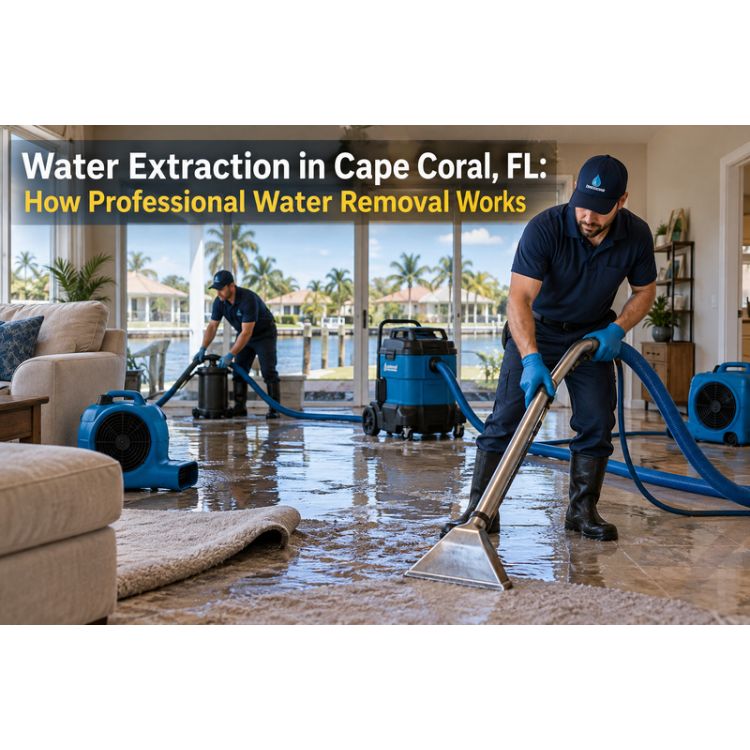
Water extraction is the first job after water gets into a building. Crews from professional water extraction services in Cape Coral pump out standing water, pull water from carpet and flooring with extractors, then use moisture meters to confirm nothing wet is left in the structure. Cape Coral's high humidity slows drying, and warm indoor temperatures can speed microbial growth in wet materials. That's why rapid extraction matters more here than in drier climates.
If water is in your home right now: leave any area with an electrical risk, stop the source if you can, call a restoration company, and call your insurer. Take photos and video before anything gets moved.
What extraction covers, and where it stops
Extraction removes liquid water: puddles, plus the water soaked into carpet, padding, and the lower parts of walls. Drying is the next stage, which removes moisture left inside materials. A full restoration job also includes assessment, repairs, and rebuilding. Extraction is the opening move, and it sets how much of the rest you'll need.
Dehumidifiers can't dry a flooded room on their own. Removing the bulk water first shortens drying time and shrinks the window where mold can start.
Why water damage in Cape Coral behaves differently
Canals and waterfront. The city's canal system feeds hundreds of miles of waterways. For canal-side and waterfront homes, outside water that enters the house is a different problem from a leaking pipe (more on that below).
Climate and aging plumbing. Subtropical weather brings heavy rain, tropical storms, and constant humidity. One local restoration provider also points to aging plumbing in some established neighborhoods as a common cause. Roof leaks, burst pipes, AC leaks, and appliance leaks don't need a storm.
Slabs and seasonal homes. Many Lee County homes sit on concrete slabs, so water often spreads sideways under flooring and into wall bottoms. A leak that runs for days in a seasonal home gets much worse before anyone notices.
After a hurricane or tropical storm, extraction usually happens alongside storm damage restoration work such as roof protection and debris removal.
How professional water extraction works
1. Safety check and source control
The crew checks for electrical hazards, structural problems, and contamination. They shut off power to wet areas when needed and stop the source.
2. Assessment and classification
A water damage assessment sets the scope for the whole job. Restorers follow the ANSI/IICRC S500 standard, which classifies water two separate ways. Category describes how contaminated the water is, and class describes how much water is present and how hard it will be to evaporate.
Categories: Category 1 is clean, Category 2 is gray, and Category 3 is grossly contaminated (black water).
Classes:
Class 1: the lightest absorption and evaporation load.
Class 2: losses that affect at least an entire room of carpet and cushion.
Class 3: the greatest evaporation load, where water may have come from overhead.
Class 4: specialty drying for very low-permeance materials such as hardwood, plaster, brick, concrete, and stone.
Category isn't fixed. Sources describing the S500 say Category 1 water can move up a category if it touches contaminated surfaces or sits stagnant for roughly 24 to 48 hours. Treat that window as a rule of thumb. The restorer decides on site, based on the source, the materials, and the conditions.
Weather also doesn't automatically mean black water. An IICRC position statement from January 2026 says water coming in from above and wind-driven rain are not automatically Category 3. Rising floodwater and storm surge are a different case. They're generally listed among Category 3 sources, alongside sewage backups.
3. Standing water removal and wet carpet extraction
Crews use submersible pumps for deep standing water and truck-mounted or portable extractors for wet carpet and hard floors. Carpet and pad from clean-water losses can often be extracted in place. Contaminated carpet and pad usually go.
4. Moisture detection
A surface that feels dry can still be wet inside. Technicians use moisture meters and infrared cameras to trace water through walls, floors, and ceilings, since missed moisture can lead to mold and deterioration later. On slab homes, ask where they checked under flooring and behind baseboards.
5. Removing materials that can't be saved
Some materials come out. Porous materials touched by Category 3 water are on that list. For everything else, the call depends on the water category, the moisture readings, and how long the material stayed wet. A good crew explains each removal and photographs it first.
6. Structural drying and dehumidification
Air movers push air across wet surfaces while dehumidifiers pull moisture out of the air. Guidance based on IICRC practice calls for inspecting drying equipment at least every 24 hours. The crew sets a drying goal and measures against it. Drying ends when the readings say so.
7. Cleaning, mold prevention, and documentation
Crews clean and apply antimicrobial treatment where the category calls for it. Fast drying is the main form of mold prevention. If mold is already visible, or materials stayed wet for days, the job moves into mold remediation. That work follows a separate IICRC standard, S520, while S500 covers the water side. Moisture logs, photos, and equipment records go in your file. Your adjuster will likely ask for them.
How fast should emergency water extraction start?
Guidelines built on IICRC practice describe a 24 to 48 hour window to dry clean-water damage and prevent mold, and they're guidelines, not guarantees, since mold doesn't always appear after 48 hours. In Cape Coral, humidity and heat make that window harder to hit, so earlier is better. After a major storm, crews get stretched across the region. Ask for an arrival time in writing when you book emergency water damage response.
DIY vs. Professional Water Extraction
Factor | Wet Vac & Fans (DIY) | Professional Water Extraction |
|---|---|---|
Best for | Small clean-water spills on sealed hard floors caught within hours | Water affecting carpet, padding, drywall, cabinets, or areas that have remained wet |
Water removal | Slow removal with limited capacity | High-capacity pumps, truck-mounted extractors, or portable extraction equipment |
Hidden moisture | Easy to miss behind walls, under flooring, or around baseboards | Moisture meters and thermal imaging can help locate hidden moisture |
Contaminated water | Unsafe without proper protective equipment and procedures | Trained crews use appropriate PPE, containment, removal, and cleaning procedures |
Drying verification | Usually based on how the surface feels | Moisture readings are taken and compared with established drying goals |
Insurance documentation | Mainly your own photos and receipts | Photos, moisture readings, equipment records, and written documentation |
Upfront cost | Lower | Higher |
Main risk | Hidden moisture can remain and cause further damage | Quality depends on the company’s equipment, procedures, and workmanship |
What a professional extraction service should include
✓ Fast arrival, with a time frame in writing
✓ Pumps and extractors sized to the job
✓ Moisture meters and thermal imaging
✓ Water category and class stated up front
✓ Daily moisture readings through drying
✓ Air movers and dehumidifiers matched to the class
✓ Photos and logs for your insurer
✓ Written scope and estimate before work starts
Pros and cons of hiring a professional
✓ Pros
✓ Removes bulk water far faster than DIY tools
✓ Finds moisture you can't see
✓ Lowers the odds of mold and repeat damage
✓ Handles flood and sewage water safely
✓ Produces records that support an insurance claim
✗ Cons
✗ Costs more upfront than doing it yourself
✗ Equipment runs for days, with noise and some disruption
✗ Availability drops after big storms
✗ Extraction doesn't repair anything, so rebuilding is a separate job
✗ Quality varies, and certification alone doesn't guarantee good work
Flood and sewage water
Flood and sewage jobs aren't DIY. Both involve Category 3 water, and crews wear protective gear, remove porous materials, and disinfect what stays. Keep children, pets, and anyone with a weakened immune system out. For the full process, see flood damage cleanup.
How much does water extraction cost in Cape Coral?
Cost depends on the water category, the area affected, how long the water sat, the days of equipment needed, and how much material comes out. One restoration company's page lists a typical Cape Coral job at roughly $1,200 to $5,000. That's a single source, so treat it as a ballpark. Black water jobs and rebuilds can run higher. Ask for a written estimate that separates extraction, drying, and demolition.
Insurance in Florida: what to verify
This section is general information, not legal or insurance advice. Policies and rules vary, so confirm with your insurer, your agent, or an attorney.
Notice deadlines. Florida Statute §627.70132 sets them. A claim or reopened claim must be noticed within one year after the date of loss, and a supplemental claim within 18 months. Notice has to follow the terms of your policy. For hurricanes, severe rain, and similar events, the date of loss is the landfall date or the date NOAA verifies the event. One Florida law firm notes that the one-year and 18-month rule applies to policies effective on or after December 16, 2022, so older policies may follow earlier rules. Report early. Waiting costs you options.
Flood is usually a separate policy. State insurance regulators say standard homeowners policies don't cover flooding, and NFIP flood policies generally have a 30-day waiting period. A policy bought as a storm approaches won't help for that storm. Wind damage that lets rain in through a roof is a different peril, so ask your carrier how it classifies your loss.
NFIP proof of loss. FEMA tells NFIP policyholders to submit the Proof of Loss form within 60 days of the date of loss. FEMA has extended that period after some disasters, so check with your carrier whether an extension applies.
Protect the property. Most property policies expect you to take reasonable steps to prevent further damage. Read your policy's wording, and keep receipts.
Mistakes that make water damage worse
Waiting to see if it dries
Wading through flood water that might be electrically live
Throwing out wet materials before photographing them
Painting over damp drywall
Treating a dry-feeling surface as a dry structure
How to verify a water extraction company
Credentials are easy to claim and easy to check. Before you sign:
Certification. Ask whether the firm and its technicians hold IICRC certification, and ask for the certificate numbers.
Licensing and insurance. Ask which licenses apply to the work, then verify them with the Florida Department of Business and Professional Regulation. Request a current certificate of insurance.
Paperwork. Ask to see a sample moisture log and a sample scope before work starts.
Local presence. Confirm a real Cape Coral or Lee County service area, not a call center routing to whoever's free.
Pricing. Get a written estimate, and be wary of large deposits before anyone sees the damage.
References. Check reviews on more than one platform and ask for recent local references.
FAQ
How long does extraction take?
Pumping and extracting in a typical home often takes a few hours. Drying afterward takes several days, depending on materials, class of loss, and humidity.
Is water extraction the same as water removal?
In everyday use, yes. Extraction is the technical term for pulling out standing and absorbed water with equipment.
Can flooded carpet be saved?
Often, when the water was clean and extraction started quickly. After Category 3 water, carpet and pad generally go.
Do I need extraction after a roof or AC leak?
If insulation, drywall, or ceiling material got soaked, yes. Moisture trapped in a ceiling or wall cavity is easy to miss.
Do commercial properties need a different process?
The process is the same, but jobs are larger and often need phased work so a business can reopen part of the space sooner. Ask any company whether it has handled jobs your size.