Written by: Rapid Restoration Group Team (Cape Coral, FL)
Credentials: IICRC-certified technicians (WRT – Water Damage Restoration, ASD – Applied Structural Drying, CDS – Commercial Drying Specialist). Firm holds Florida State Mold Remediation licensing (MRSR) under Florida Statute Chapter 468. Locally owned water damage restoration company serving Cape Coral and Southwest Florida.
Reviewed by: Eli Goins, Florida-licensed Public Adjuster (FL DFS License #P159790), Ocean Point Claims Company, LLC
Last updated: September 2026 · Facts last verified: September 2026
✅ Key takeaways
🔍 Inspection finds and confirms damage. 📋 Assessment measures it, classifies the water, and gives you a repair plan and estimate.
🧪 Florida law separates mold assessment from mold removal. The same company can’t do both on one property within 12 months. This covers mold, not general water-damage assessment.
⏰ One year to give notice of a new property claim in Florida. 18 months for supplemental claims.
💸 Check your policy for a “limited water damage” cap and a mold sublimit.
🌊 In a Cape Coral flood zone, repairs costing 50% or more of the building’s value trigger flood-compliance rules.
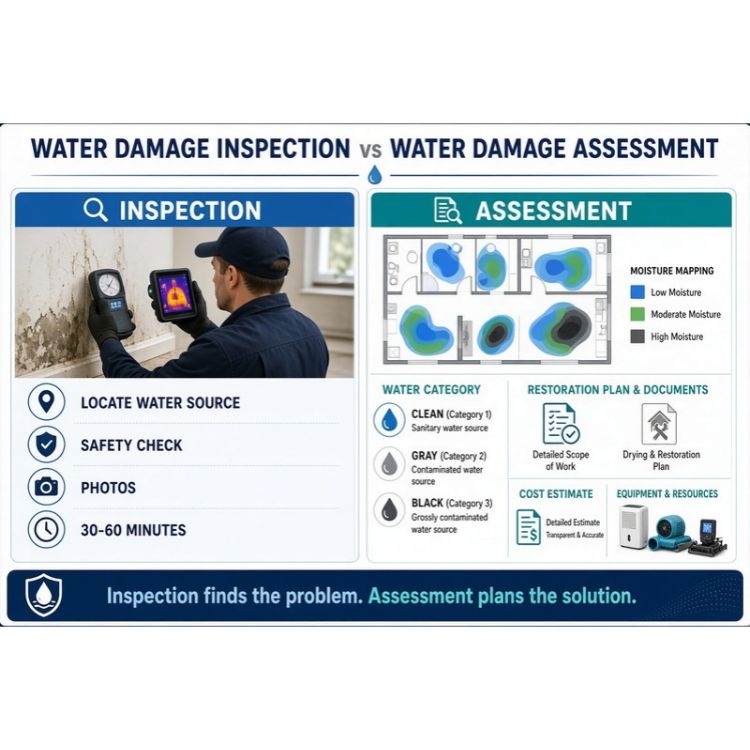
Short answer: An inspection finds and confirms water damage. An assessment goes further: it measures the extent of damage, classifies the water, and produces a plan and cost estimate. Inspection tells you what’s wrong. Assessment tells you what to do about it.
🤔 Why people mix up the two words
No law defines “inspection” and “assessment” for general water damage, so companies use them however they like. One firm’s “free inspection” is another firm’s “assessment” with the same checklist.
The industry’s main reference, the ANSI/IICRC S500 standard, does separate the early work. Its table of contents lists inspections, preliminary determinations, and pre-restoration evaluations as their own section (current edition 2021).
A better question than “which word?” is: “What will I have in my hands when you leave findings or a plan?”
🔍 What an inspection covers
An inspection is a search for water and its source. The inspector looks for:
Stains, bubbling paint, peeling wallpaper
Floors that cup, buckle, or feel soft
Swollen baseboards and door frames
A musty smell with no visible cause
Active leaks near pipes, water heaters, appliances, windows, and the roof
Technicians commonly bring infrared cameras and moisture meters to see what’s wet, how wet, and how far it has spread.
You get: Findings where moisture sits and a probable cause.
📋 What an assessment adds
An assessment turns findings into decisions. It doesn’t repair anything, but it shows exactly what you’re dealing with. A good one answers six questions:
Source: Where did the water come from, and has it stopped?
Contamination: How dirty is it?
Extent: How much material is wet, and how deeply?
Salvage: What can be dried, and what has to come out?
Safety: Any electrical hazards, sagging ceilings, or sewage?
Plan: What will the work take in steps, equipment, days, and money?
💧 Categories and classes
Category | Contamination | Typical source |
|---|---|---|
1 | Clean at the source | Broken supply line, overflowing sink |
2 | Some contamination | Washing machine or dishwasher discharge |
3 | Seriously contaminated | Sewage backup, river or storm flooding |
Categories measure how dirty the water is. Classes (1 to 4) measure how much water soaked in and how hard materials are to dry. Class 4 means deep saturation in dense materials like hardwood, plaster, or concrete. Every loss gets both.
Carpet hit by Category 3 water is treated as unsalvageable and gets removed.
⚠️ Where sources disagree: how fast water “gets dirtier”
One restoration reference says Category 1 water not removed within 48 hours moves to Category 2, and gray water can reach Category 3 within 72 hours (sooner in warm conditions).
Another guide says Category 1 can degrade to Category 2 within 24 hours and to Category 3 within 48 hours.
Neither is a hard rule. Temperature, what the water touched, and the materials all matter. The assessor makes the call on site.
⚖️ Inspection vs Assessment – Side by Side
🔍 Inspection | 📋 Assessment | |
|---|---|---|
Purpose | Find and confirm damage | Judge severity, plan the fix |
Core question | What’s wrong, and where? | How bad is it, and what next? |
You receive | Findings | Written report, scope of work, estimate |
Best for | Early problem-spotting, home purchases | Active water losses, insurance claims |
Typical provider | Home inspector, plumber, restorer | Restoration pro, adjuster, independent consultant |
👍👎 Pros and Cons
Inspection
👍 Pros | 👎 Cons |
|---|---|
Quick and focused | No plan or estimate |
Early warning for slow leaks | Severity can stay unclear |
Useful in home sales | Hidden moisture can still be missed |
Low commitment | Often not enough for insurance |
Assessment
👍 Pros | 👎 Cons |
|---|---|
Gives a clear plan with scope, equipment & estimate | Takes longer |
Classifies water (drives safety and cost) | Cost varies (some firms charge, some waive) |
Builds strong documentation for insurance | Quality varies |
Includes follow-up monitoring | Fixes nothing itself |
Flags related risks | Possible conflict if the same company also does the repair |
Rule of thumb: Inspect when you’re checking. Get an assessment once water has actually entered the building.
💵 What it costs in Cape Coral
Service | Typical Range in Cape Coral | Notes | Date Checked |
|---|---|---|---|
Inspection only | Free – $350 | Often free if work proceeds | Sep 2026 |
Assessment (single room) | $200 – $500 | Includes moisture mapping + report | Sep 2026 |
Assessment (whole house) | $350 – $800+ | Depends on size and complexity | Sep 2026 |
Independent assessment | $250 – $600+ | Third-party / consultant rates | Sep 2026 |
Many restoration companies (including us) waive the assessment fee when you move forward with mitigation and insurance billing.
📏 Why a moisture number means little on its own
A meter reading only makes sense next to a reference (dry standard). Dry drywall, framing lumber, and concrete all read differently. EPA-referenced guidance requires technicians to set a dry standard from unaffected material of the same type.
🔁 An assessment doesn’t end at the first visit
Drying equipment should be checked at least every 24 hours. Ask: “Is daily monitoring included in the price?” Surface-dry walls are a common reason mold appears weeks later.
🧫 Mold: where the two services stop and start
EPA guidance points to a 24–48 hour window. A water assessment does not automatically include mold testing. Mold work follows the separate S520 standard. Ask for it as its own service.
🌴 Cape Coral and Florida: what changes locally
1. Florida separates mold assessors from mold removers
Under Chapter 468, Part XVI, a mold assessor may not perform or offer remediation on a structure the company assessed within the last 12 months. This rule applies to mold only — not ordinary water damage.
2. Florida claim deadlines are short
What | Deadline | Source |
|---|---|---|
New or reopened property claim | Notice within 1 year of date of loss | §627.70132 |
Supplemental claim | Within 18 months of date of loss | §627.70132 |
Insurer’s decision | Generally pay or deny within 60 days | §627.70131 |
3. Check for a “limited water damage” cap
Many policies (especially older homes) now carry a $10,000 water damage limit plus a separate mold sublimit. Check your declarations page today.
4. Water damage vs flood damage
Standard homeowners policies do not cover flood, surface water, or rising tidal water. NFIP has a 30-day waiting period.
5. The 50% rule
In AE or VE flood zones, if repair costs reach 50% or more of the building’s value, the whole structure must meet current flood-zone construction standards. A clear line-item assessment becomes a key document for the city.
🧰 Cape Coral Quick Checklist
Photograph and film the damage before removing anything
Call your insurer and get a claim number
Ask about your water damage cap and mold sublimit
Get a written assessment with dry standard and line-item estimate
If mold is found, use separate DBPR-licensed assessor and remediator
Check your flood zone before permitting repairs
Keep all receipts, reports, and permit paperwork
🛠️ From the field: Real Cape Coral Jobs
Case 1: High-pressure supply-line rupture – Tarpon Point Marina area
Owner saw: Sudden flooding from ruptured reverse-osmosis line under kitchen sink.
Inspection found: 800+ gallons across 2,600 sq ft of Brazilian cherry hardwood and travertine; wood moisture ~28% WMC.
Assessment changed: Category 1, Class 3–4; used weighted extractors + Injectidry mats instead of full tear-out.
Result: Extracted within 35 minutes; dried to 8.4% with zero cupping; 100% of original hardwood saved (≈ $48,000 replacement avoided).
Lesson: Fast mechanical extraction can save high-end floors that look destroyed.
Case 2: Pressurized supply-line flood – Pelican neighborhood
Owner saw: Returned home to flooded open-concept kitchen/dining/living area.
Inspection found: ~450 gallons; 1,400 sq ft LVP + subfloor saturated; moisture wicked 16 inches up drywall; structural readings >46%.
Assessment changed: Full moisture map, category/class, closed drying chamber with LGR dehumidifiers, clear dry vs remove decisions.
Result: On-site in 38 minutes; 95% water extracted in 90 minutes; studs at 8% EMC in 72 hours; no mold.
Lesson: A thorough assessment turns “everything is wet” into a measurable plan that supports the insurance claim.
👷 Who does the work
Role | What they do | Watch out for |
|---|---|---|
Home inspector | General condition, often at sale | Rarely maps moisture in depth |
Plumber / Roofer | Finds and fixes the source | Doesn’t plan drying |
Restoration company | Inspects, assesses, dries, repairs | Writes the scope and profits from it |
Insurance adjuster | Evaluates the claim | Works for the insurer, not you |
Independent consultant | Assesses with no repair to sell | Extra cost and scheduling |
🧭 Which one should you book?
Book an inspection if... | Book an assessment if... |
|---|---|
You smell mustiness but can’t find it | Water has already entered the building |
You’re buying or selling a home | You’re filing an insurance claim |
You want to check an old roof or crawl space | You need a drying plan with real numbers |
You suspect a slow leak in a wall | An earlier inspection found moisture |
If water is coming in right now, call a restoration company and ask for both in one visit.
📄 What a useful report includes
Visit date and estimated date of the water event
Water source and whether it’s stopped
Category and class with reasoning
Room-by-room readings and the dry standard
Moisture map or marked-up photos
Materials to dry vs remove
Equipment list and expected drying time
Monitoring plan
Mold risk notes
Line-item estimate
🚨 Before the professional arrives
Shut off the water at the main valve if a pipe is leaking.
Cut power to wet areas only if safe.
Photograph and film everything first.
Lift small items off wet floors.
Keep every receipt.
❓ FAQ
Is an inspection the same as an assessment?
No. Inspection locates damage. Assessment evaluates it and plans the fix.
How soon should I get one?
As soon as it’s safe. EPA guidance points to the first 24–48 hours.
Can the same Florida company assess and remove mold?
Not on the same property within 12 months. This applies to mold only.
How long do I have to report water damage in Florida?
One year for a new claim and 18 months for supplemental damage. Report sooner.
Does an assessment include mold testing?
Usually not. Ask separately.
Can I do it myself?
You can spot stains and soft spots. You cannot accurately judge hidden moisture or water category without professional tools.
What if the adjuster’s numbers don’t match mine?
Share your photos, readings, and dry standard. Consider an independent opinion if the gap is large.