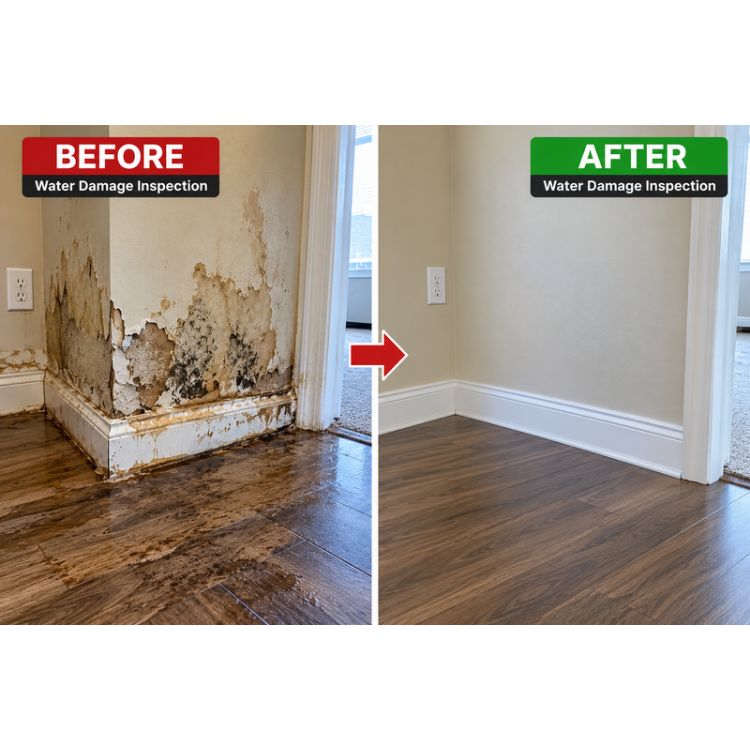
A water damage inspection in Cape Coral is more than checking for a wet carpet or a brown mark on the ceiling. A proper inspection looks at the source of the water, how far it traveled, which materials absorbed it, and whether moisture remains in places you can't see.
That last part matters. Water can move beneath flooring, behind drywall, into cabinets, and through other parts of a building assembly. A room can look mostly dry while moisture remains in materials that need attention.
A professional inspection combines visual observations with moisture measurements and an assessment of the affected building materials. The findings help determine whether the property needs drying, material removal, repairs, mold remediation, or further evaluation.
Why a Water Damage Inspection Matters
Water damage can spread beyond the area where the leak first appeared.
Imagine a supply line leaking inside a kitchen cabinet. The cabinet may show the first obvious signs, but water can also reach the flooring underneath it, travel toward an adjoining room, or enter the wall around the plumbing connection.
That's why professionals look for the extent of water migration, not just the place where water is visible.
A water damage assessment may consider:
Where the water came from
When the water intrusion occurred
How long materials may have remained wet
Which rooms and materials were affected
Whether moisture has migrated beyond the visible area
Moisture levels in affected and unaffected materials
Signs of deterioration
Potential microbial growth
HVAC or plumbing involvement
What materials may be salvageable
What drying or restoration work may be required
The ANSI/IICRC S500 standard includes inspections, preliminary determinations, pre-restoration evaluations, building and material science, drying technology, instruments, structural restoration, and HVAC restoration within professional water damage restoration practice.
What Professionals Look For During a Water Damage Inspection
A good inspection starts with the visible evidence but doesn't stop there.
The inspector is trying to build a picture of the entire water event:
source → migration path → affected materials → moisture conditions → damage → next action
That sequence is more useful than simply recording that a wall or floor "looks wet."
Visible Water Damage Signs
The first clues are often easy to spot.
Professionals may look for:
Ceiling or wall staining
Discoloration
Bubbling or peeling paint
Swollen drywall
Damaged baseboards
Warped flooring
Buckled wood
Wet carpet or padding
Swollen cabinets
Standing water
Musty odors
Visible mold
Areas with unusual dampness
These signs help identify where the investigation should begin.
But visual inspection has a limitation: a material can look normal and still contain elevated moisture.
That's why moisture measurement becomes important when the circumstances suggest water has moved into concealed areas.
Hidden Moisture Behind Walls, Floors, and Cabinets
Hidden moisture is one of the main reasons a professional water damage inspection can be different from a quick visual check.
Water can move through or beneath building materials. It may collect:
Behind drywall
Beneath flooring
Under carpet padding
Inside cabinets
Around plumbing penetrations
Along baseboards
Near windows and exterior walls
Around appliances
In concealed areas below or beside the original leak
EPA guidance specifically recommends investigating areas where moisture problems have occurred because hidden mold growth and water damage can occur in building materials such as drywall and carpet.
Why Adjacent Rooms Matter
One common mistake is inspecting only the room where water is visible.
Water doesn't necessarily stop at a doorway.
For example, water from a bathroom leak may migrate beneath flooring into a hallway or nearby room. A professional assessment may therefore include areas next to the original loss, even when those areas don't show obvious surface water.
The inspection should follow the likely migration path rather than an arbitrary room boundary.
How Professionals Measure Moisture
A moisture inspection isn't based on whether a wall feels damp to the touch.
Professionals may use different instruments depending on the material and the question they are trying to answer.
Common equipment includes:
Non-invasive moisture meters
Pin-type moisture meters
Moisture sensors
Thermo-hygrometers
Temperature instruments
Thermal imaging cameras
Other equipment used to evaluate environmental and material conditions
The IICRC S500 identifies moisture detection equipment and other instruments as part of water damage inspection and restoration practice.
Moisture Meter Inspection: What the Reading Actually Tells You
A moisture meter reading isn't meaningful by itself.
The result needs to be interpreted in relation to:
The material being tested
The instrument being used
The meter's settings
Nearby unaffected material
Environmental conditions
The purpose of the measurement
This is why experienced professionals often compare affected materials with similar unaffected materials.
The IICRC's inspection guidance describes establishing a dry standard using comparable unaffected materials and using that information to establish drying goals for salvageable materials.
In simple terms, the question isn't merely:
"Is this number high?"
It's:
"Is this material behaving differently from comparable material that has not been affected?"
That distinction makes moisture data much more useful.
Why Thermal Imaging Doesn't Prove Water Is Present
Thermal imaging can be useful during a water damage inspection, but it has an important limitation.
An infrared camera detects differences in surface temperature. A cooler area may be associated with evaporation from wet material, but temperature differences can have other causes too.
For that reason, a thermal image shouldn't automatically be treated as proof of hidden water.
IICRC guidance notes that areas suspected to be wet through thermal imaging should be verified with appropriate moisture measurement.
That makes thermal imaging a supporting diagnostic tool, rather than a replacement for moisture measurement.
Checking Drywall, Flooring, and Structural Materials
Different materials react differently when exposed to water, so professionals don't treat every wet surface the same way.
Drywall and Gypsum Board
Drywall may show:
Staining
Swelling
Softening
Damaged seams
Surface deterioration
Elevated moisture
The decision to dry or remove drywall depends on the circumstances, including the type and extent of water exposure and the condition of the material.
EPA guidance notes that some wallboard can be dried in place when there is no obvious swelling and seams remain intact, while damaged material may need removal.
Flooring and Subfloors
Flooring needs attention beyond the visible surface.
An inspection may consider:
Carpet
Carpet padding
Hardwood
Laminate
Vinyl
Tile
Wood subflooring
Other floor assemblies
Carpet is a good example of why surface appearance can be misleading. EPA guidance specifically points out that carpet backing or padding also needs to be dried; drying only the visible carpet isn't enough.
Wood and Structural Materials
Wood framing, subfloors, and other structural components may require moisture assessment when water has entered the building assembly.
The purpose isn't simply to label something "damaged." The inspection helps determine whether the material is wet, whether drying is practical, and whether additional structural evaluation is needed.
The IICRC S500 includes structural restoration and building/material science because water damage can involve more than cosmetic surfaces.
Plumbing-Related Water Damage
Identifying the source is a key part of the assessment.
Common plumbing-related sources include:
Supply-line leaks
Drain-line leaks
Water heater failures
Toilet leaks
Washing machine hoses
Dishwasher connections
Refrigerator water lines
Sink and faucet leaks
Pipe failures
Stopping the leak is essential, but source repair and water damage restoration are not necessarily the same task.
The IICRC S500 states that determining and correcting the underlying source of water intrusion is generally the property owner's responsibility, although specialized professionals can be contracted to perform that work.
So a restoration company may identify evidence of a plumbing failure and recommend that the plumbing issue be corrected by the appropriate specialist.
HVAC-Related Moisture and Water Damage
HVAC systems deserve attention when moisture appears near air-conditioning equipment, condensate components, ducts, or related areas.
EPA recommends keeping air-conditioning drip pans clean and condensate drain lines unobstructed.
If water damage or suspected microbial contamination involves an HVAC system, the situation may require additional evaluation rather than simply drying the surrounding room.
IICRC maintains separate guidance for HVAC restoration following water, fire, or mold damage events, reflecting the fact that HVAC systems can introduce additional considerations.
Water Damage After Storms and Flooding in Cape Coral
Water intrusion after a storm isn't always the same as a small indoor plumbing leak.
The inspection needs to consider:
Where the water entered
How long the building was exposed
Which materials became wet
Whether contaminated water may have entered the property
Whether electrical hazards are present
Whether HVAC equipment was affected
Whether materials can be safely cleaned and dried
Flood water can carry sewage, chemicals, debris, and other contaminants. EPA advises that flooded homes may require professional help when cleanup is difficult or unsafe.
This is also why homeowners shouldn't assume that every water-loss situation can be handled with fans and household cleaning products.
Signs of Mold After Water Damage
Mold isn't a separate problem from moisture. Moisture is one of the conditions that allows indoor mold to grow.
Possible warning signs include:
Musty odors
Visible mold
Persistent dampness
Discoloration
Repeated condensation
Materials that remain wet
Previous water damage that wasn't completely dried
EPA identifies moisture control as the key to controlling indoor mold and recommends drying wet or damp materials within 24–48 hours after a leak or spill when possible.
That timeframe is a prevention target, not a guarantee. Building materials, temperature, humidity, the amount of water, and other conditions can affect what happens.
If visible mold is already present, simply painting over it isn't a solution. The moisture problem needs to be corrected and the mold addressed appropriately. EPA and CDC both emphasize correcting the underlying moisture problem.
What Happens During a Professional Water Damage Assessment?
The exact process varies with the property and the type of water intrusion, but a useful assessment generally moves through several stages.
1. Identify the Source
The inspector determines what is known about the water intrusion and whether the source is still active.
2. Establish the Affected Area
The inspection follows visible evidence and likely water migration paths.
3. Examine Building Materials
Walls, floors, ceilings, cabinets, insulation, and other affected assemblies may be evaluated.
4. Take Moisture Measurements
Appropriate instruments are used to identify elevated moisture and compare affected areas with suitable reference areas.
5. Document Findings
Photos, notes, measurements, affected areas, and other relevant information can help establish the scope of the work.
6. Determine the Next Step
The findings may lead to drying, removal of damaged materials, repairs, further evaluation, or restoration.
For larger restoration projects, inspection and documentation are not one-time activities. IICRC S500 includes ongoing inspection and monitoring as part of water damage restoration.
Why Moisture Monitoring Matters After the Initial Inspection
Finding wet material is only the first step.
If drying equipment is installed, professionals need a way to determine whether conditions are actually improving.
That may involve repeated measurements of:
Material moisture
Temperature
Relative humidity
Other relevant environmental conditions
The purpose is to confirm that the drying process is moving toward the established goal rather than simply leaving equipment running for an arbitrary amount of time.
This is one area where professional restoration differs from the common assumption that "the fans have been on, so it's dry."
What Happens After the Inspection?
The inspection findings can lead to several different outcomes.
The Area Is Dry
If the affected materials are dry and there is no evidence of continuing moisture, additional restoration may not be necessary.
Targeted Drying Is Needed
If materials have elevated moisture but can be salvaged, controlled drying may be recommended.
Damaged Materials Need Removal
Some materials may be too deteriorated, contaminated, or otherwise unsuitable for restoration.
The Water Source Needs Repair
A plumber, roofer, HVAC professional, or another specialist may need to correct the source.
Mold Remediation Is Needed
If mold growth is present or significant moisture-related contamination exists, additional remediation may be required.
Full Water Damage Restoration Is Needed
For larger losses, the project may involve extraction, structural drying, cleaning, controlled removal, and reconstruction or repair.
The correct response depends on the actual findings. An inspection should help narrow that decision rather than automatically lead to the same treatment for every property.
Water Damage Inspection vs. Water Damage Restoration
These terms are closely related, but they describe different parts of the process.
Water Damage Inspection | Water Damage Restoration |
|---|---|
Finds and evaluates affected areas | Addresses the identified damage |
Looks for visible and hidden moisture | Removes water and dries materials |
Measures moisture where appropriate | Monitors drying progress |
Assesses affected materials | Cleans, restores, or removes materials as needed |
Helps define the scope of work | Performs the restoration work |
May identify the need for specialized experts | Coordinates or performs appropriate restoration tasks |
An inspection answers "What is happening?"
Restoration addresses "What needs to be done about it?"
In real projects, the two can overlap because inspection continues as drying and restoration progress.
When Should You Schedule a Water Damage Inspection?
A professional inspection can make sense when:
A pipe or appliance has leaked
A roof leak has affected the interior
Flooring has buckled or warped
A ceiling has developed a new stain
You notice a persistent musty odor
Water has entered behind cabinets
A room was flooded
A storm caused water intrusion
You suspect moisture behind a wall
Previous water damage was cleaned but you're unsure whether materials dried completely
You find recurring moisture in the same area
You don't need to wait for visible mold before taking a moisture problem seriously.
EPA and CDC both recommend prompt drying after water intrusion because prolonged moisture increases the risk of mold growth.
Common Water Damage Inspection Mistakes
Inspecting Only the Visible Stain
The visible stain may represent only one part of the affected area.
Using One Moisture Reading as the Answer
A single reading doesn't establish the condition of an entire wall or floor assembly.
Treating Thermal Images as Proof of Moisture
Thermal imaging can identify temperature differences, but suspected wet areas should be verified with appropriate moisture measurement.
Ignoring Unaffected Comparison Areas
Without an appropriate reference, it can be harder to interpret whether a material's moisture level is unusual.
Checking Only the Room Where the Leak Occurred
Water can migrate into adjacent areas and concealed assemblies.
Assuming Dry to the Touch Means Dry
Surface feel isn't a reliable substitute for appropriate moisture assessment.
Painting Over Water or Mold Damage
Paint can hide a stain temporarily, but it doesn't correct the source of moisture. CDC specifically advises against covering mold with paint or caulk before the moisture problem and mold have been addressed.
FAQ
What is a water damage inspection?
A water damage inspection evaluates where water entered a property, how far it migrated, which materials were affected, and whether elevated moisture remains. The findings help determine the appropriate next step.
How do professionals find hidden water damage?
They combine visual inspection with appropriate moisture detection equipment. Depending on the situation, they may inspect adjoining rooms, cabinets, flooring, wall areas, plumbing locations, and other parts of the building assembly.
Can a wall look dry but still have hidden moisture?
Yes. A surface can appear dry while moisture remains within or behind a building material. This is one reason moisture measurements can be useful after a leak.
Does a moisture meter work on every material?
No. Different materials and meter technologies have different characteristics and limitations. Readings need to be interpreted according to the material, instrument, settings, and comparison conditions.
Does thermal imaging detect water?
Not directly. Thermal cameras detect temperature differences. A suspected wet area identified through thermal imaging should be verified with appropriate moisture measurement.
How soon should water damage be inspected?
As soon as reasonably possible, especially when materials are still wet. Early assessment can help identify the source, limit continued exposure, and begin appropriate drying.
Does every water-damaged home need mold testing?
No. Mold testing isn't automatically necessary simply because water damage occurred. EPA states that when visible mold is present, sampling is often unnecessary; addressing the moisture problem and visible mold is generally more important.
Is water damage inspection the same as mold inspection?
No. A water damage inspection focuses on water intrusion, moisture, affected materials, and restoration needs. A mold assessment addresses suspected or confirmed mold contamination and has its own considerations.
Final Takeaway
A good water damage inspection in Cape Coral is an investigation, not just a visual walkthrough.
The inspector needs to understand the source of the water, follow its likely migration path, identify affected materials, measure moisture appropriately, and recognize areas that may need additional evaluation.
The most useful questions are simple:
Where did the water go? Which materials are still affected? And what should happen next?
Those answers provide a much better basis for restoration than simply treating the most obvious stain.
For homeowners dealing with a plumbing leak, roof leak, appliance failure, storm intrusion, or flooding, prompt assessment and drying can help limit secondary moisture problems. EPA and CDC guidance both emphasize drying wet materials as quickly as practical, with 24–48 hours commonly used as an important target for reducing mold growth risk.